converter resources contact us help view cart
Jewelry Making SuppliesContenti Jewelry Making Supplies resources, contact us, help, view cart  


Tips & Tricks

The following collection of tips was drawn from the winning entries of our monthly Tips & Tricks Contest. Each winner has received a $25 Gift Certificate from contenti.com and has been featured in our monthly e-newsletter. For more information visit our Contest Entry Form.

Keep Polishing Compound out of your bezels - November'08
When polishing a bezel set stone, it's difficult to keep polishing compound from getting under the stone and into the bezel. To prevent this problem, wet the stone before polishing and apply baking powder, covering the stone and especially the top edge of the bezel. The baking powder will help prevent polishing compound from getting under the stone and is easily removed with water once polishing is complete. This process is really helpful with stones or glass that are light colored or clear.
Submitted by: Christal Keener

Protecting Stones During Tumbling - September '08
Have you ever wanted to put a jewelry piece back into the tumbler after you have set the cabochon(s)? It's possible, using this trick. Apply enough Tool Magic™ or Plasti Dip® to cover the stone and allow it to cure (about 2 hours). For additional protection, recoat and allow to cure. Then place the piece into the tumbler. It's a good idea to check the piece every five minutes or so to be sure that the stone remains protected. This works very well with steel shot. Use additional caution when tumbling with more aggressive media. Once tumbling has been completed, the rubber coating peels off of the stone quite easily.
Submitted by: Roxanna Santoro

Easier Metal Crocheting - August '08
Crocheting with metal wire is a popular technique. But, holding a thin crochet hook handle can be hard on your hands. To make crocheting easier and more enjoyable, wrap an elastic bandage (e.g. Ace® bandage) around the center of the handle many times until it forms a big lump covering the center third of the handle. The bandaged lump provides a larger grip and will conform to the shape of your hand as you use the hook.
Submitted by: Stephanie Riger

Polishing Small Details - July '08
Polishing jewelry that has very fine details can be difficult to accomplish without removing some of the detail. To make the job easier (and safer), apply a small amount of polishing compound to a wooden toothpick and use it to get into the tight spots. As an alternative, apply the compound to a small piece of chamois cloth placed over the toothpick. If you think creatively, just about anything can be a tool!
Submitted by: Christina Goebel

Seamless Gold soldering - June '08
Prevent visible weld seams and broken shanks when sizing gold rings. Use the next highest karat weight of hard solder than the karat weight of the material your working on. For example, if your job is a 14karat yellow gold then use 18karat yellow hard solder. Do not over heat your weld as this may cause porosity and weakness in the brazed joint. Not to mention the destruction of the work.
Submitted by: Paul Piazza

Easy Pricing Formula - May '08
Keep an index card for each of your production pieces, listing materials by piece or weight,and assembly time. Write a pricing formula, using "x" for spot market price and "y" for length of product - be sure to include your profit margin. That way it's easy to adjust prices when the market rises or falls, or for different lengths/sizes of that piece. For example: ((x+25+30)/y)1.3 In other words... Take the spot market price(x), add your hourly rate($25) and any additional materials($30). Divide that total by the length(y), then multiply by your profit margin(1.3/30%).
Submitted by: Sam Kaffine (Sterling Bliss)

Charcoal Block Soldering - April '08
Instead of digging notches in your charcoal block to hold your work while soldering, cut the block lengthwise into three pieces. Put the pieces back together, then stretch two steel springs around the outside and secure the ends with binding wire or by twisting the spring ends together. When you are ready to solder, pry the charcoal block apart and place your piece in the slot. The tension from the springs will hold your work upright without additional support. You can place your piece close to the block, allowing the heat from your torch flame to reflect back to the piece, making it easier to solder.
Submitted by: Steven Jugo

Tagging Solder Wire - March '08
Keep track of your wire solder by taking a square of sheet metal (brass, nugold, nickel silver, copper) and write the kind of solder on the face (in felt tip pen or metal stamps). Drill a few small holes along the bottom and thread the corresponding wire solder through the holes and twist to secure. You can easily snip off sections of solder as needed and the different metals are a visual cue to the type of solder on each. Drill a hole at the top of the square of metal and hang it on your peg board for easy access.
Submitted by: Wendy Oestreicher

Homemade Porosity Tool - February '08
A broken drill bit can be made into a very effective porosity tool with little effort. Start by breaking off any remaining cutting edges. Then, using a torch, heat one end of the broken bit until it is glowing red. Allow the bit to cool on its own(do not quench). Once cool, place the bit in a vice and bend a 2 cm long L shape into the end. File the end to a rounded point, leaving a smooth finish. Before using, heat the tip again until it glows red. Remove the flame and quickly submerge the tool in water to harden it. Mount the tool in your flexshaft handpiece and remove porosity as needed. ALWAYS REMEMBER TO WEAR EYE PROTECTION!
Submitted by: Andy Thomas

Color-Coded Solder - January '08
If you use sheet solder, color code it with a marking pen. Use red for hard, blue for soft and black for med. That way, if you find stray solder snippets on your desk or floor, you know exactly what you have by the color. It also makes it easier to put different types on your solder station, so you don't have to stop each time to change solders. A quick glance at the color will tell you what you have.
Submitted by: Carol Hettenbach

Embossing Metal Sheet - November '07
Brass templates used for paper embossing can also add texture to silver and copper sheet. Place the brass template on top of your metal sheet and run through your rolling mill. The template should hold up for several passes through the mill and give a nice sharp image transfer. These templates can be found at most craft stores among the scrap booking supplies.
Submitted by: Heather Loney

Working like a Clock - October '07
When using multiple pliers and hand tools, place them in the same order before you on your workspace. You can use the numbers on a clock as a reference, placing tools at the 9, 12, and 3 o'clock positions with your workspace as the center. You'll soon become accustomed to the placement of your tools and not have to take your eyes off of your work to pick them up when you need them.
Submitted by: Bonnie Elliott

Homemade Heat shield - September '07
Soldering links (or other elements) to fine chain can be difficult to accomplish without over-heating the chain itself. To protect the chain during soldering, use a small scrap of copper or brass sheet supported in locking tweezers as a heat shield. Position the chain so that it is behind the heat shield with the link to be soldered sticking out slightly. Bring your torch flame from the same direction as the heat shield such that it reaches the link but is deflected by the shield from overheating the chain. This trick works especially well with larger torches that don't have small/precise soldering tips.
Submitted by: Sondra Sherman

Alternative Soldering support - August '07
When positioning oddly shaped or delicate parts for soldering, using a "third arm" or binding wire is not always the best approach. For these difficult soldering jobs, try using scrap pieces of copper to keep your parts in place. Just bend the copper scraps into table or sling-like shapes to support your pieces, then coat them with a solder-flow prevention compound such as liquid correction fluid (e.g. WhiteOut™). The copper supports will keep your parts positioned, while the coating prevents solder from adhering to the copper. This technique works especially well with parts that are impossible to bind together with traditional binding wire.
Submitted by: Marilynn Nicholson (Taos Jewelry School)

Making a Miniature Brass Brush - July '07
Have you ever had trouble getting into small spaces with a standard-size brass brush? If you don't have a small brush at hand, you can easily make your own. Cut a small piece of copper or brass tubing (the type used for hinges on small boxes). Pluck several bristles off an old brass brush and insert them into one end of the tubing. To keep the bristles in place, simply crimp the tubing with a pair of pliers or your bench vise. Now you have a cheap, go-anywhere miniature brass brush for cleaning rings and other small items.
Submitted by: JoseCarlos Villalon

Keep your sketches in sight - June '07
After making sketches of the designs you would like to make, don't leave them on your bench top to get dirty and be "in the way". Instead, hang them up and out of the way with a curtain rod and curtain clips. Mount a curtain rod on the wall in front of your bench and secure the drawings with simple curtain clips (available at most hardware/decorating stores). This will help keep your work surface less cluttered and keep your sketches in sight.
Submitted by: Alaina Burnett

Quenching & Pickling... The dry way - May '07
This is an easy way to keep your hands dry in the studio: poke holes in a clean plastic yogurt container with a hot nail. Place the container in your quenching bowl, and drop small parts into it as soon as they are soldered. Pick up the container with your copper tongs, and submerge it into the pickle. When it's ready, pick it up again with the copper tongs, let it drain, and then submerge it into a vat of clean water. Swirl it around a few moments, then drain the water and pour the parts onto a drying cloth.
Submitted by: Evelyn Arvey

filing bezel wire the easy way - April '07
Because it's so thin and flexible, bezel wire is not always easy to work with. To make filing easier, hold the wire in a pair of flat nose pliers, leaving 1 mm of the wire end sticking out to the side of the pliers jaws. File off the excess wire until it is flush with the pliers. Repeat for the other end of the wire. If the back of the plier jaws (where the joint is) is at a right angle to the sides and the bezel wire is carefully aligned with the back of the jaws, the filed ends will be absolutely flat and square, making them easy to solder. Just be sure not to squeeze the pliers too tightly or you will mash the bezel wire.
Submitted by: Noël Yovovich

Preventing Stuck Paste Flux - March '07
Sitting down to a solder job and finding the lid to your paste flux jar "glued-on" can be frustrating. Follow these simple steps to ensure that this doesn't happen. After you've finished your soldering work for the day, simply wipe down the grooves on the flux jar before replacing the lid. Then, store the jar upside down in a dish of water. The water will prevent the flux from drying out. Voila! No more sticky lid!
Submitted by: Kristi Zevenbergen

Quick & Easy Wire basket Soldering - February '07
When soldering basket settings for gem stones, bore out a dish shaped indention in a charcoal block with a sphere or cone shaped abrasive wheel. Position your V-shaped wire parts into the dish so that the sides of the dish support the formed wire and the points are clustered in the bottom of the dish. Then, simply solder the wires together. The increased stability makes soldering quicker, easier and more accurate than other methods.
Submitted by: James Hutchinson

Stuck on beading - January '07
Picking up small beads, like heishi and seed beads, can be difficult. Instead of using your bare fingers, use a rubber finger cot (or surgical gloves) with a small amount of rubber cement applied to the tip. You want to use only enough cement to make it tacky, allowing you to pickup those small items with ease. The cot will protect your fingers from the adhesive and the adhesive will save your beads from being lost.
Submitted by: Steven J Jugo

Stop Grating Your Teeth - December '06
Cut a short piece of rubber surgical tubing (approximately 5" long) and pull it over the threaded part of your polishing motor arbor before attaching your buffing wheel. Then, if the piece you are polishing should accidentally rub against the arbor, you don't have to worry about it being scratched or chewed up by the threads. A great low-cost solution that works extremely well.
Submitted by: Jan Werner

When two wires are better than one - November '06
When making earrings or any other "two-of-a kind" pieces with wire, you can save yourself considerable time by making both pieces at one time. Just lay your wires side-by-side and tape them together at both ends. Then, use your pliers to work the wires into the desired shape. When you've achieved the result you're looking for, remove the tape and voila! You now have two perfectly matched pieces that took you half the time it would normally have taken.
Submitted by: Suellyn Snobeck

Never Lose Your Chuck Key Again - October '06
Constantly misplacing your flexshaft chuck key? A retractable id badge holder or retractable key chain is the perfect solution to this all-too-common problem. One costs only a few dollars, can be easily secured to your bench top and has a long stainless steel cable with a sturdy locking ring at the end. Simply attach the base to your bench (or any other convenient place) and secure your chuck key with the lock ring. You'll never waste time searching for the key under a pile of tools again.
Submitted by: R.E. Rourke

Keeping Your Metal Clay Moist - September '06
There are few things more disappointing than sitting down at your bench and finding that the lump of metal clay you were about to use has dried-up into an unworkable, useless blob. Keeping your unused PMC or Art Clay moist is much easier with a package of Soil Moist granules from your local garden center and an empty film canister. Place 1 teaspoon of Soil Moist granules into the film canister (or other air-tight container) along with 1 tablespoon of distilled or tap water. Allow the granules to absorb the water, then pour off any excess. To use, simply place your metal clay (wrapped in plastic wrap) into the container. The Soil Moist granules will keep your clay from drying out and prolong its life indefinitely. And when the granules begin to lose their moisture, just add a few drops of water to the container. It's that easy!
Submitted by: R.E. Rourke

Coordinating Colored Beads - August '06
Take a "Chip & Dip" platter or similar plastic plate with divided sections and paint each section a different color. Choose primary and secondary colors as in a traditional color wheel, or color themes such as warm hues, cool hues, or seasonal colors. Once dry, the tray(s) can be used to help coordinate colored beads for projects. Place the beads on the tray and move from section to section until the desired color combination is achieved. This is a great way to find uses for left-over beads and for experimenting with unique color combinations.
Submitted by: Deb K. Oller

Making Metal Clay Texture Plates - July '06
Begin with a thick sheet of Sculpey(r) or other polymer clay material. A 3" x 4" piece with a thickness of approx. 1/4" works well. Using an antique button, rubber stamps, metal screen material, or any other object with texture, make repeated impressions in the clay sheet. Overlapping the impressions in some areas and using a variety of objects, will make the texture plate more interesting. Once you are satisfied with the texture, trim the clay sheet to 2" x 3" and bake at the manufacturer's recommended time/temperature. You now have a custom-made texturing plate to add more interest to you metal clay creations. Simply, coat the polymer clay sheet with olive oil to keep the metal clay from sticking.
Submitted by: RobinBeth Faulkner

Extending the Life of Sanding Discs - June '06
When your snap-on sanding discs become worn out along the edge, you can easily extend their life using a sharp knife. With the disc mounted in your handpiece and running at a moderate speed, place the tip of the knife on the underside of the disc. Bring the knife blade up, cutting off the outer edge of the disc. This will leave you with a smaller disc with a fresh cutting edge. This technique can also be used to true a new disc that is mounted off-center. ALWAYS REMEMBER TO WEAR EYE PROTECTION!
Submitted by: David Huffman

CUSTOMIZE YOUR FILES - May '06
Extend the usefulness of your files by creating "safe" edges on them. Using a large grinding wheel or sanding belt, remove the teeth from one of the cutting edges, leaving a smooth, non-abrasive surface (take care not to overheat your files while grinding). This will enable you to file in tight areas without effecting adjacent surfaces. You can also use this technique to fine-tune files that already have safe edges but the teeth of the cutting edge(s) may extend beyond the safe edge.
Submitted by: Robert Coogan

STORING TINY DRILL BITS - April '06
Tired of loosing those tiny drill bits on you benchtop? Here's an easy way to keep your small drills organized and within reach. Place a piece of beeswax along the edge of your benchtop and insert your drills, pointed end first, into the wax. When you need them, simply remove from the block and use. As a bonus, the wax film left on the drill will act as a lubricant, making drilling easier and the drill bit last longer.
Submitted by: Jessica Daman

ROLL YOUR WAY TO A PERFECT BEZEL - March '06
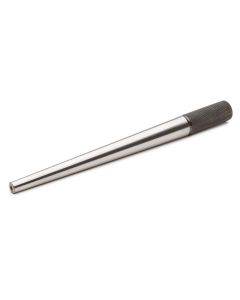
Kinks in your bezel? Or is it a little too small for the stone? Use the thin, delicate quality of the bezel material to your advantage. Slide the unfinished bezel onto an appropriately shaped bezel mandrel and roll the bezel on a hard surface, as if it were a rolling pin. The rolling action will smooth out any kinks in the bezel and enlarge it slightly. The more you roll, the larger the bezel will become. Anneal and repeat if necessary.
Submitted by: Anne Wolf

LOOK FORWARD TO SAWING - sample tip
When sawing through sheet metal, always keep your eyes focused slightly ahead of your sawblade. By looking several millimeters ahead, you will have less of a tendency to make"choppy" corrections when your cut strays. Just like driving a car, you want to pay attention to what's in front of you, instead of what is directly below you at that moment. The result? Smoother curves, straighter lines, and less filing/finishing.
Submitted by: The Contenti Company


home  |   contact  |   help  |   resources  |   site map

Contenti Jewelry Making Supplies, Jeweler's Tools, Beading Supplies, & Metal Working Tools

New Items | Specials | Gift Ideas | Spin Casting | Abrasives | Adhesives | Anvils & Stakes | Art Clay | Beading Supplies | Bench Pins | Benches | Books
Brushes | Burs  | Casting | Cleaning | Dapping | Diamond Tools | Dispensing Tools | Drawplates | Drills | Engraving Tools  | Files | Flexshafts | Gauges
Hammers | Knives | Lamps | Magnifiers | Mandrels | Metals | Plating | Pliers | Polishing | Punches & Stamps | Ring Tools | Rolling Mills | Safety
Saws | Scales | Shears | Soldering | Stone Setting | Storage | Store Supplies | Testing | Tool Kits | Tumbling | Tweezers | Videos | Vises | Watch Tools

website design by Peter Nassoit
© 2008 The Contenti Company, 515 Narragansett Park Drive, Pawtucket, RI 02861
terms of use | privacy policy